Liyuan Wan

USC Marshall · AI for Business · Los Angeles

Data & BI analyst who ships real products.

Hi, I’m Liyuan (Leo) Wan. I like digging into revenue data with SQL and Python, and when I need a tool that doesn’t exist I usually just build it, from little browser utilities to an AI agent that writes its own SQL and checks its work. What I care about most is where careful analysis meets AI. Right now I’m a software engineering intern at Knovus.ai, where I measure and fix the practice questions on an AI study platform.

Transactions analyzed
1.85M
Tools shipped
6

01 — Case Studies

Analysis you can audit.

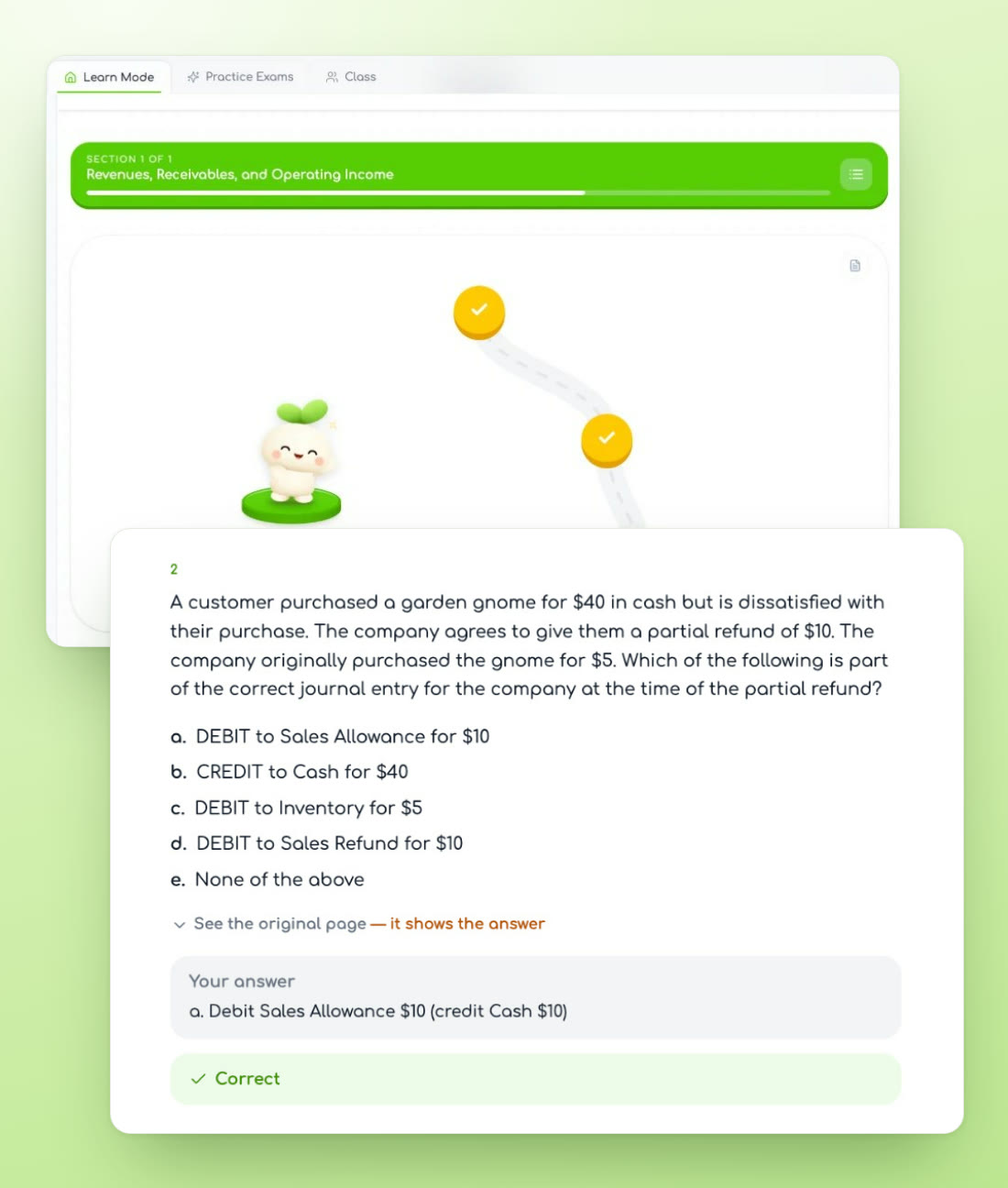
Two Knovus screens, one in front of the other. Behind: Learn Mode, a study path for the section Revenues, Receivables, and Operating Income with two completed steps and the sprout mascot. In front: a practice card, an accounting multiple-choice question about a partial refund, copied word for word from the course file, with the student's answer marked correct
Back: Knovus today, a course turned into a study path. Front: a practice card from my first version, the question copied word for word from the student’s own file, then graded.

Sep 2026 – Present · Internship · FastAPI · Next.js · pytest · LLM evaluation

Knovus.ai: Making Practice Questions Answerable

Knovus is an AI study platform that turns a student’s course files into lessons and practice questions. My part is the practice questions: figure out if students can actually answer them, fix what’s broken, and prove the fix works.

  • I sampled 90 stored questions across 16 courses and had each one judged by three independent reviews: 53% couldn’t be fully attempted. It wasn’t the AI model’s fault, the format the questions got saved in just had no place for the full question text.
  • I wrote my manager a proposal with two options, and he forwarded it to the founder and the rest of the team. He picked grading each question against its original page in the course file, which I built, so about 2,400 existing questions kept working without being reprocessed. It got merged into the production code on Sep 28, and he later built on it with PowerPoint and Word previews.
  • A page often has several questions on it, so in round two I turned each one into its own card, copied word for word and checked by 9 rules plus a model. On 60 random production questions I got 37 clean cards and 0 serious errors, it caught all 54 mistakes I planted, and it cost about $0.37 in model calls. (It also wrongly rejected 1 of 8 cards that were already fine.) It was merged and turned on by default Oct 22, and the team has reworked it since.
  • My first grader test scored 100% across 120 gradings, which honestly was suspicious, so I reported it as a failed test and made the cases harder. That caught the cheaper grader marking 1 of 20 wrong answers as right, so the one that shipped is the slower grader that solves the problem first: 0 of 20.
  • 18 of my commits are merged into the production branch, across the FastAPI backend and the Next.js frontend, including about 250 tests.
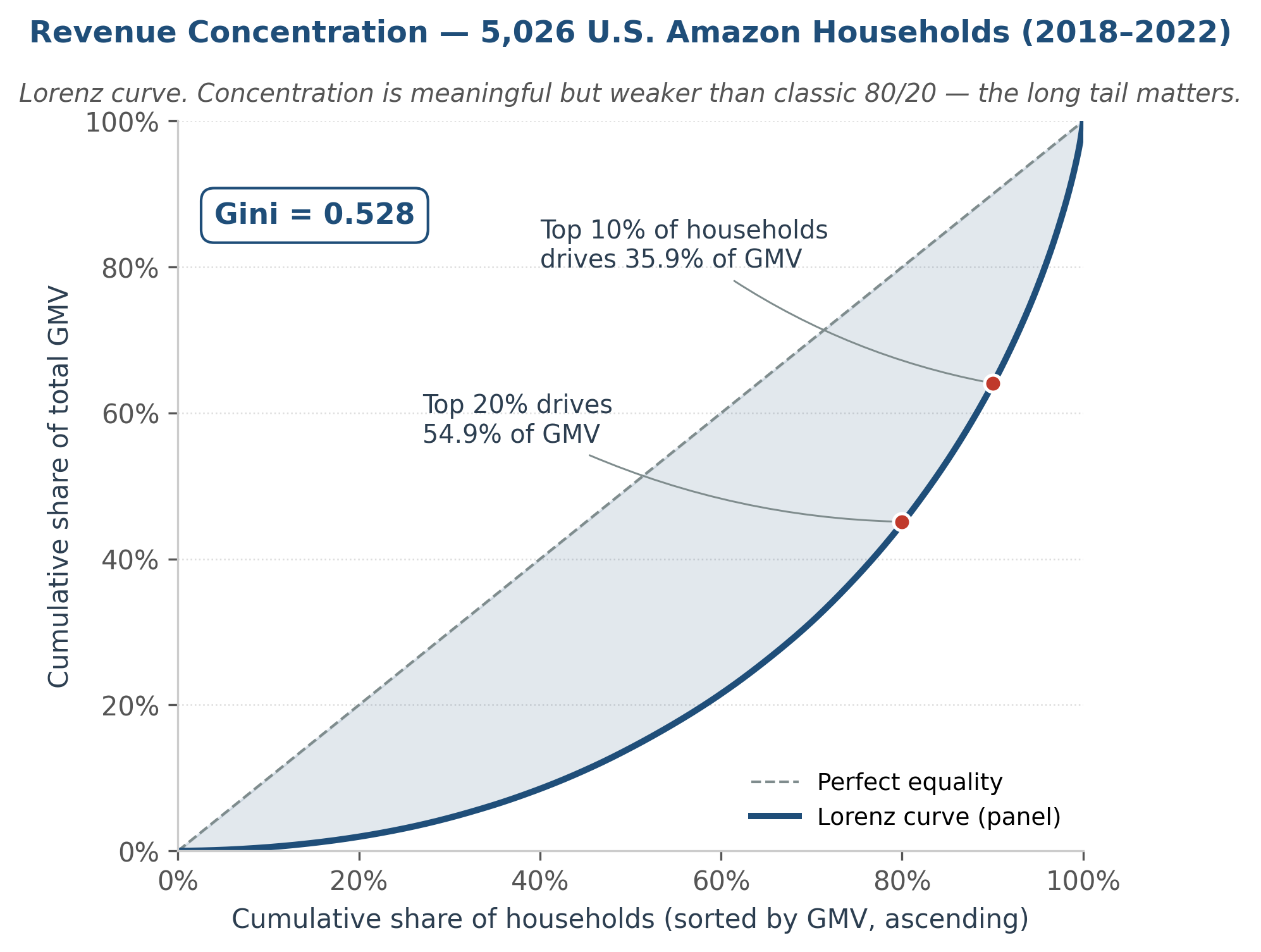
Lorenz curve of revenue concentration across 5,026 U.S. Amazon households, Gini 0.528
Lorenz curve for the 5,026 households. The top 10% spend 35.9% of the money.

May – Jul 2026 · SQL · DuckDB · Python · scikit-learn · Tableau

Amazon Revenue Analytics

Where does the revenue come from, what’s at risk next quarter, and where should the category budget go? I answered that in SQL and Python on about 1.85M purchases from 5,026 U.S. Amazon households, 2018–2022.

  • The top 10% of households spend 35.9% of all the money (Gini 0.528), and about 95% of their lead comes from ordering more often, not from bigger orders.
  • The middle-to-lower spenders (deciles 6–9 of 10) hold 64% of next quarter’s revenue-at-risk but only 14% of the spending. So the households worth protecting aren’t the top spenders.
  • Halfway through I found out my raw file had been cut off at a spreadsheet’s 1,048,576-row limit, and 43% of the rows were just gone. I re-ran everything on the full file and added a check that fails loudly if it ever happens again.
  • The drop-off model holds up on households it never saw: AUC 0.90, where 0.5 is a coin flip (trained on shuffled outcomes it gets 0.53). Key results have 95% confidence intervals, and SQL and Python cross-check every total.
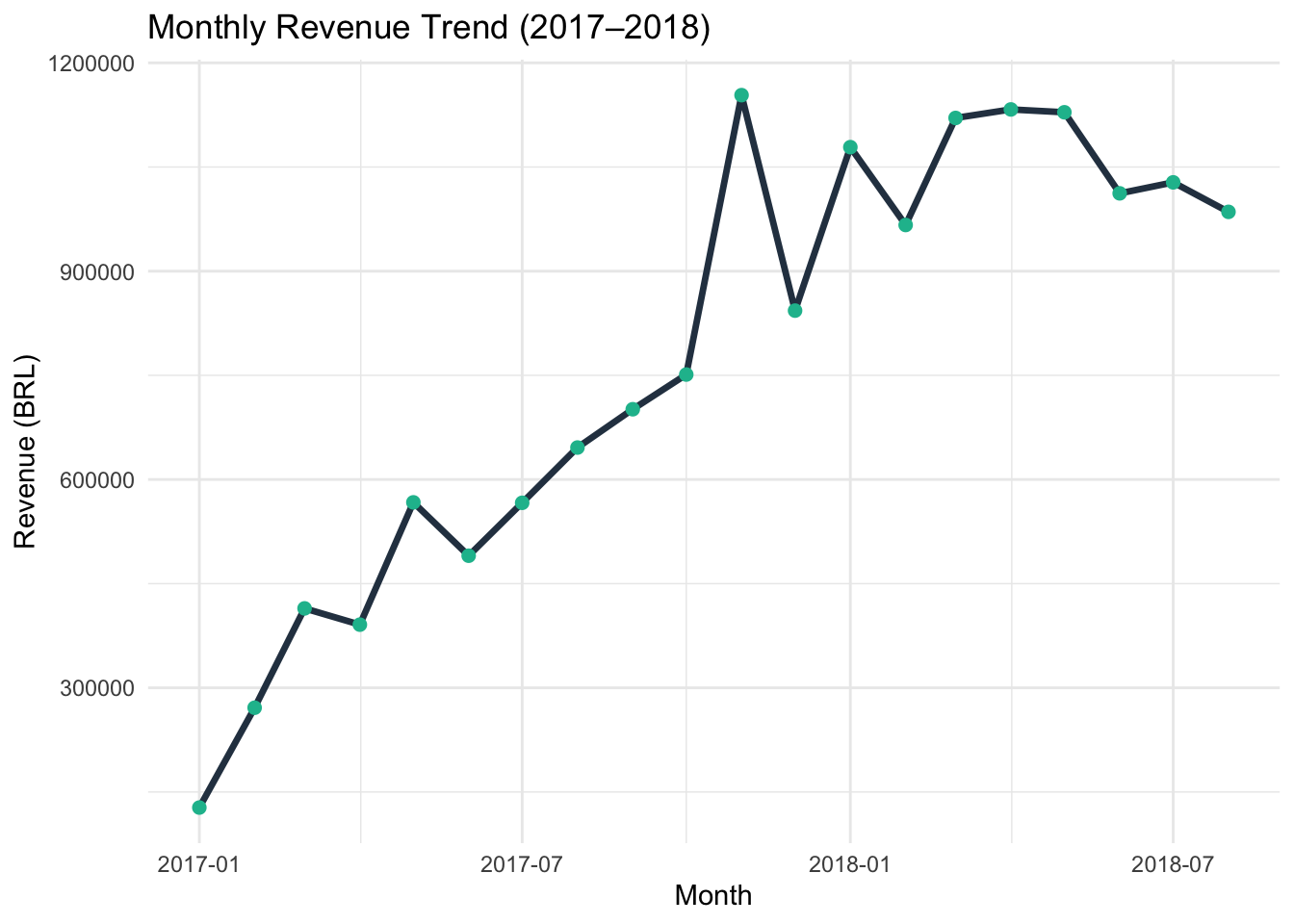
Monthly Olist marketplace revenue in BRL, 2017 to 2018: a steep ramp-up through 2017, then a plateau near one million per month
Monthly revenue from 96K+ delivered orders, 2017–2018: a steep ramp-up, then a plateau near R$1M a month.

Jan – Apr 2026 · PostgreSQL · R (tidyverse) · HTML/JS

Marketplace Revenue Risk: Olist

How steady is a Brazilian marketplace’s revenue, how much of it depends on one region and a few big orders, and how long does the cash take to show up? I looked at 96K+ delivered orders to find out.

  • The top 10% of orders bring in 38% of revenue (Gini 0.475), and São Paulo alone brings in 37%.
  • About 64% of revenue gets paid in installments, 4.12 on average, so the cash shows up well after the sale.
  • Monthly revenue swings a lot (CV 0.42), but a lot of that is just 2017’s fast growth. With the trend taken out the swings are smaller.
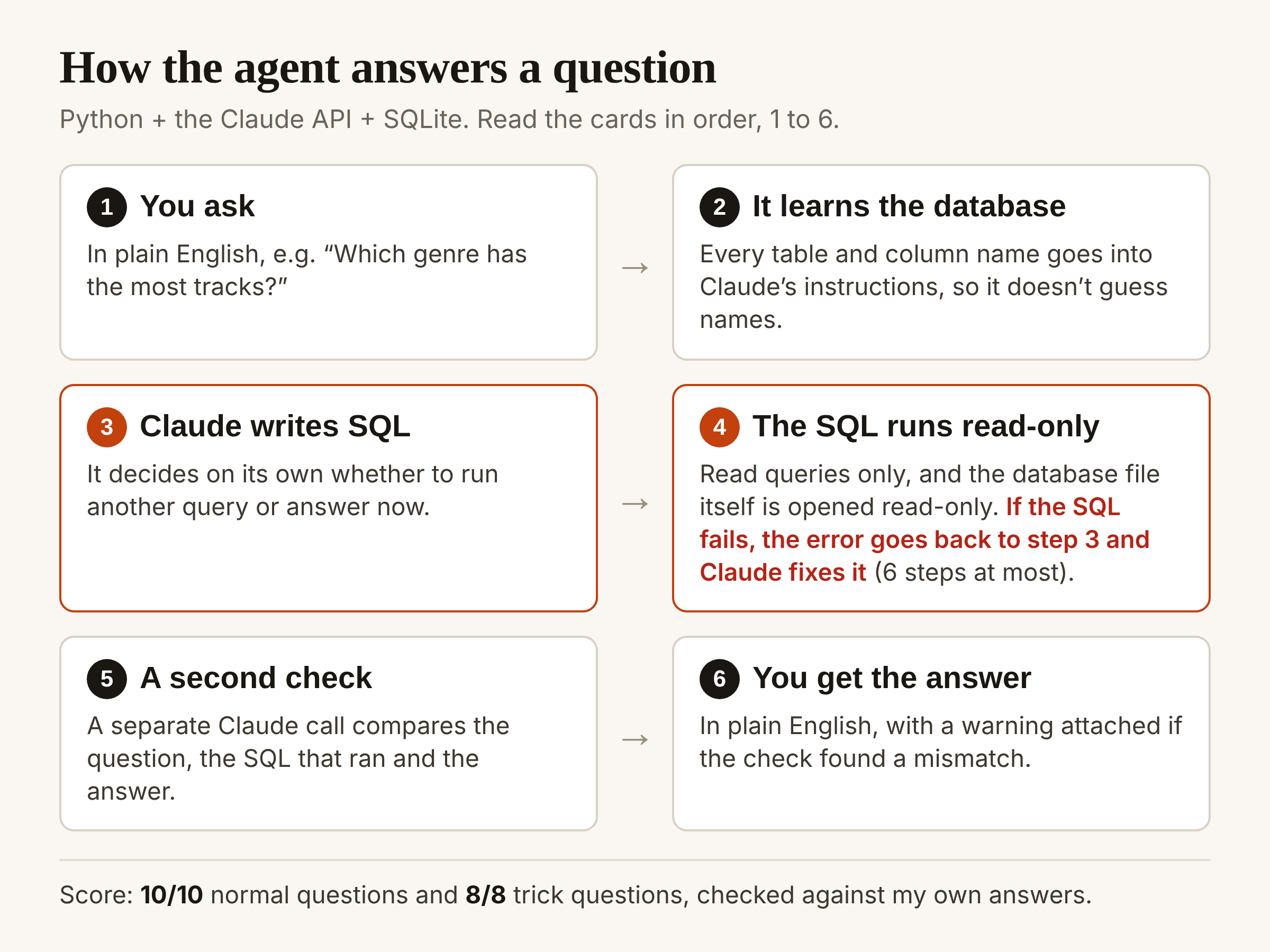
Six steps: you ask in plain English; every table and column name goes into Claude's instructions; Claude writes SQL; it runs read-only, and on an error goes back to Claude to fix; a second Claude call checks the answer; you get the answer, with a warning if the check found a mismatch
Steps 3 and 4 are the loop: Claude writes the SQL, reads any error, fixes it, and decides when it’s done.

Jun – Jul 2026 · Python · Claude API · SQLite · pytest

Text-to-SQL Agent

You ask a question in plain English and the agent writes the SQL, runs it on a read-only database and fixes its own errors. I built it to learn how AI agents actually work, then tested it like a BI tool instead of a demo.

  • 10/10 on normal questions (simple counts up to 4-table joins) and 8/8 correct SQL on trick questions (synonyms, date filters, missing values, vague metrics), all checked against answers I computed myself.
  • The trick questions turned up a confident-guessing failure mode: on a vague question the agent quietly picks one meaning and doesn’t tell you which. That’s exactly the risk that matters when non-analysts ask their own questions.
  • A second check reviews each answer against the SQL that ran, so a quietly wrong answer comes with a warning. 48 automated tests (no API key needed) run on every push.

02 — Shipped Products

Things people can actually use.

Jun 2026 · PySide6 · Claude Code hooks · calm-tech

BEACON

A little glass-domed lighthouse that floats over your windows and shows what Claude Code is doing in real time. When the agent needs you, the dome turns to amber dusk and the beam stops and turns toward you. Run a few agents and each one gets a small boat, and the one waiting on you sails to the front. I tuned it for precision over recall, because after one false alarm people just close an ambient tool.

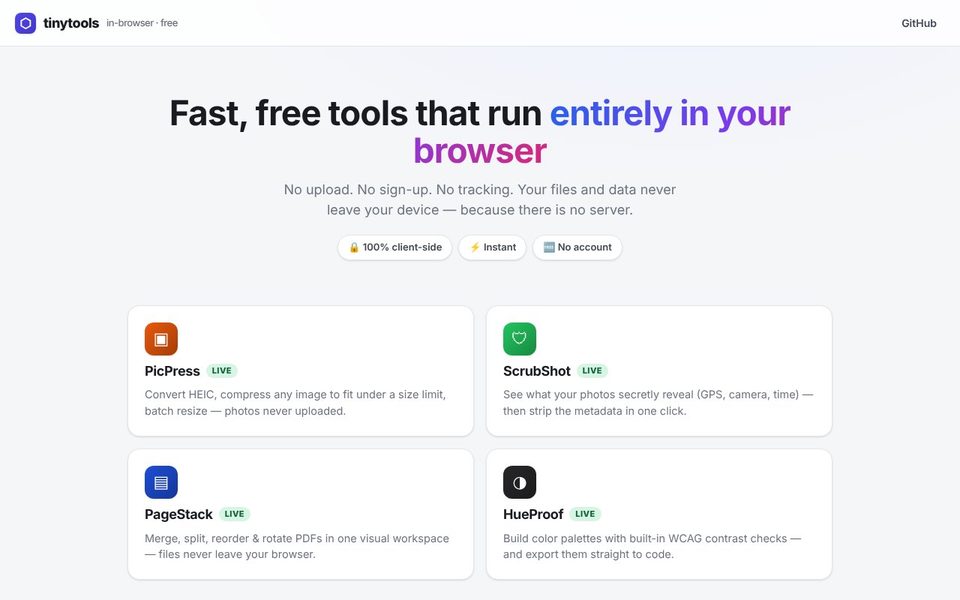
tinytools homepage: fast, free tools that run entirely in your browser

Jun 2026 · Vanilla JS · zero servers · zero tracking

tinytools

Four free tools that run entirely in the browser, so nothing ever leaves your device. PicPress converts and compresses images, ScrubShot strips photo metadata, PageStack edits PDFs and HueProof builds palettes with WCAG contrast checks.

Cyberdeck: neon cyberpunk skyline with synthwave sun, rendered live in Canvas 2D

Jun 2026 · Canvas 2D · 60 fps · no libraries

Cyberdeck

A cyberpunk live wallpaper plus a full VS Code and Claude Code theme. Neon skyline, synthwave sun, a scrolling grid floor, all drawn by hand in Canvas 2D, and one script installs it.

03 — About

Where I’ve been, what I use.

Experience

Sep 2026 – Present

Knovus.ai · Software Engineering Intern, Los Angeles

An AI study platform. I measure and fix how it builds and grades practice questions, in Python/FastAPI and Next.js/TypeScript. Details above ↑

Oct 2026 – Present

USC Marshall · Research Assistant to Prof. Mohammed Alyakoob

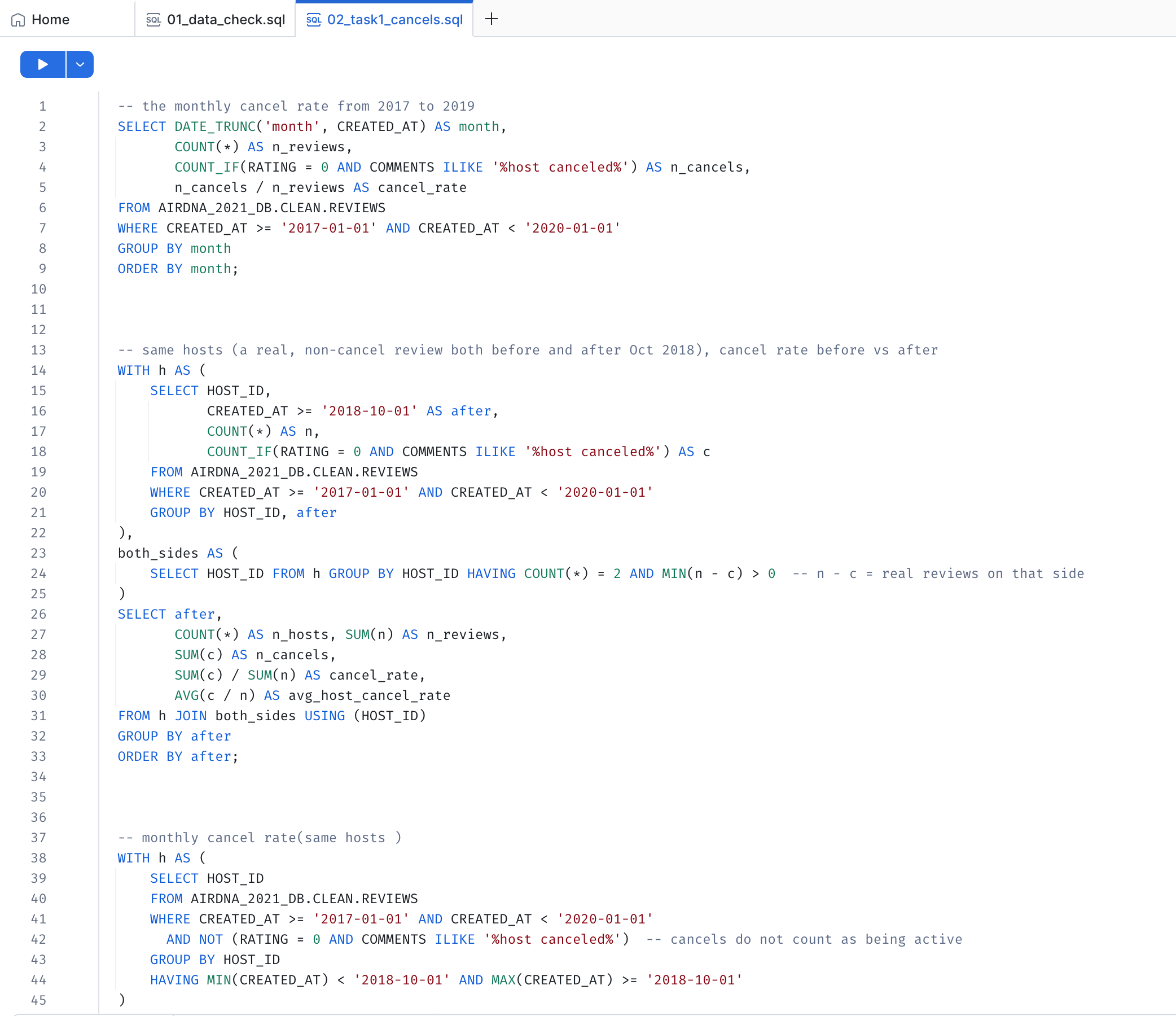
We’re looking at how Airbnb host cancellations changed around a 2018 policy change, in SQL on Snowflake. Before doing any analysis I checked 6.78M reviews from 2017–2019. 98.2% of the 0-star reviews were automated “host canceled” posts and the rest were real reviews that just had no rating, so I only count a cancellation when both signals agree.

My Snowflake worksheet: SQL that compares the same hosts' cancellation rates before and after October 2018; query results are not shown
My Snowflake worksheet. Results stay with the project for now.

Sep 2026 – Present

USC Marshall, Data Sciences & Operations · Tutor, BUAD 312

The department picked me to tutor Statistics & Data Science for Business. I run a weekly 2.5-hour help session open to 60+ students across two sections, and answer one-on-one questions on regression in R, hypothesis tests and bootstrap CIs.

Sep – Dec 2025

Marshall Artificial Intelligence Association · Member, Los Angeles

Learned the terminal, Git, GitHub workflows and AI-assisted coding, which is basically the toolkit behind everything on this page.

Jul – Aug 2023

Everbright Securities · Analysis Intern, Guangzhou

Tracked price movements across 50+ equities, wrote daily market summaries for the internal investment team, and helped grow a WeChat market-commentary audience by 1,000+ subscribers.

Education

Expected May 2029

University of Southern California · Marshall & Viterbi

B.S. Artificial Intelligence for Business · GPA 4.0/4.0
Dean’s List · Alec Gores Scholarship · Phi Kappa Phi Sophomore Recognition

Toolkit

AI
LLM evaluation, adversarial test design, failure-mode analysis, tool-calling agents (Claude, OpenAI, Gemini)
Programming
Python (FastAPI, Pydantic, pandas, scikit-learn), SQL / PostgreSQL, TypeScript / Next.js, R, C++
Data & BI
Snowflake, DuckDB, Polars, Tableau, bootstrap CIs, regression & hypothesis testing
Engineering
Git, pytest, Docker